Sunday, January 8, 2012

JANUARY 7

Backward and forward

It was exactly one year ago that I moved to Vienna, and yet I can remember everything about it in the most minute detail as if it were yesterday. It started with a packed van in Portland, Maine on the morning of January 6th, continued down the highway through New Hampshire, Massachusetts, Connecticut and New York to JFK airport, lasted for over eight hours in the air above the Atlantic and western Europe, and ended on a cold, rainy, wonderful day the next morning in Vienna. And while I know so much has happened since then, I still can’t quite understand how it is actually now 365 days later!
There are of course many, many things I could write (and have written) about my experiences here so far, but the best I can do at this moment of reflection is to say that I am 100% content, and have 0% regret. This was the right decision on every level, and the wonder of it all still unfolds before me in new ways each and every day.

I’ve made local friends and expat friends, found employment, met fascinating people as students and colleagues from all over the world, and put down roots in the place where my roots began. What more could I ask for?

I won’t say it’s been easy being away from family and friends from before, because it hasn’t, but with e-mail and Skype I don’t feel as cut off as I otherwise might be from those I love. And speaking of those I love, being here has brought me closer to my parents than ever before, and in ways I’m not sure I’m yet able to describe. They never shared too much of their Viennese childhoods with me, each for different reasons. Yet the pull that the city and culture exerted on them, in spite of everything, seems to be in my blood, and gives me an inexpressible sense of truly being home.

So, it being a new year, and a time for looking forward as well as backward, what are my plans and resolutions for the next 365 days? Here are my top three:


1.  To become completely self-supporting.

I am thrilled with my new teaching profession, and managed to already earn back a large part of what it cost me to live here this past year. My business plan for 2012, though, is to earn enough to support myself entirely from my work as an English trainer, editor, and executive coach, without tapping any previous resources.

2.  To improve my German.     

How many times have you heard that one by now? The fact is, I can indeed understand a whole lot more now than when I arrived. I do fairly well at shopping, making appointments, listening to conversations, reading light material and such, but speaking is another matter. Even though I can usually make myself understood, the grammar and colloquialisms are a real challenge.

That said, I think I may be starting to look like a local, because just this morning, on two separate occasions in town, I was asked for directions. Not only were the conversations in German—I knew where and how to direct them!

Meanwhile, I found a humorous take on this subject by a German comedian who does stand-up in Great Britain, and I invite you to take a look so you can see what I’m up against. He’s got 10 separate skits, which you can get to from the Web site, but this is my favorite:
Click Here

3.  To cope with turning 60

What is there to say? I don’t relate to that number at all; it simply does not compute. Sure, both body and mind are a little worse for wear, but this ‘change of life’ has been very rejuvenating. And if the expression ‘Bis hundertzwanzig’ ('til 120) means anything, I’m only halfway through! In any case, I am entirely optimistic about my future here, and if I can just work out a way to see more of my kids, life will be perfect.
~ ~ ~ ~ ~ ~ ~ ~ ~ ~ ~ ~
So ... assuming Obama makes it back into the White House (things are looking up a little bit, no?), I think 2012 is going to be a very good year. And when I’m not preparing for lessons or grading papers and exams, I really hope to also do some more exploring and experiencing in this wonderful city—and, perhaps, even beyond. And maybe you can too! With thanks to my friend Janice and the New York Times, I’d like to share with you just a few of the many attractions in store for both residents and visitors. You don’t have to all come at once … but please do come! It’s really worth the visit.


~ ~ ~ ~ ~ ~ ~ ~ ~ ~ ~ ~

HAPPY NEW YEAR! 
Einen guten Rutsch ins neue Jahr!


New Year’s themes in Austria include the greeting above (which translates literally as ‘Have a good slide in the new year’), and the pig as a symbol of good luck and prosperity. In the days between Christmas and January 1, vendors popped up all over the city with pigs of every variety:


And on that note, let me wish you all a 
Spectacular, Happy, and Healthy 2012!

Tuesday, December 27, 2011

A Jew's Christmas in Vienna

(…with apologies to Dylan Thomas)
I suppose it could be said that I see things in Vienna through rose-colored glasses, both because I am so happy to be here and because I feel at home in a culture that is very familiar to me. And even though the streets and stores have been crowded with busy gift shoppers, I don’t sense the same materialistic madness as in the U.S., like the post-Thanksgiving Black Friday midnight crush, or the pepper spray aggression at Walmart! There is also virtually no trace of tacky flashing light displays, inflated lawn Santas or other gaudy decorations.
But don’t get me wrong … the city is certainly ‘dressed up’ for the holiday. Stunning but tasteful lights adorn the major pedestrian thoroughfares; little pine forests have sprung up everywhere with beautiful, fragrant specimens for sale; and dozens of markets – called Kristkindlmarkts – abound, in major tourist locations as well as some local neighborhoods. The tradition, it seems, dates back to the Middle Ages, and many items have become quite clichéd, but walking among the chalet-like wooden huts with our noses frozen by the cold, hands warmed by mugs of glühwein (mulled wine) or Punsch (punch), and tummies sated with Maronen (chestnuts—yes, roasted on open fires), Würstel (sausages), Krapfen (jam-filled donuts), and Lebkuchen (gingerbread), it’s almost impossible to resist the seasonal spirit, even for a nice Jewish girl from New York!
So here’s a glimpse of some of my Christmas wanderings. There were many other markets that I visited, and even more that I didn’t get to visit … but there’s always next year!
Kristkindlmarkt in front of the Rathaus (city hall)
Christmas lights on the Graben
And then one day a pine forest "grew" on the Graben ...
... and in so many other places, including in front of this church.
"Old Vienna Xmas Market" 
Mixing business (gift shopping) with pleasure (eating and drinking) !
Yummy - Der Lebkuchen schmeckt mir sehr gut!

Even sent some home to my 'cookie punk' offspring!

Handcrafted tree ornaments of infinite variety 
Who knew the Austrians were such apiarists?
Honies and beeswax candles make extremely popular gifts.
 
Christmas must-haves, right?
More tree and house decorations 
Basketry is also popular, year-round 
Austrian president, Heinz Fischer, visits
(not my photo)
(Click on the link, and scroll down to just below where you'll see this photo. Hover your mouse over the little black box and click on the arrow to watch a little clip:) 


And don’t believe everything you hear about the reserved and unfriendly Viennese. The (native) neighbors on my floor are some of the nicest people you’d ever want to meet. One, an older gentleman who absolutely adores Scout, came to my door on Christmas Day with biscuits for her and a box full of home-made­ Vanillekipferl for me. 

Almost as good as Oma's

But don't worry, I haven't forgotten my heritage; I lit Hanukkah candles at my window faithfully every night: 
The glow from the candles on my parents' menorah
shone out onto the streets of Vienna for eight nights.


Saturday, November 19, 2011

So This is Austria!

A country in love with its rules

It seemed like a good idea at the time. But if I had known beforehand what I was getting myself into, I never would have started.

As I may have mentioned earlier, the public transportation system here (which I just learned is referred to as die Öffentlichen Verkehrsmittel, or Öffis for short) is one of the best in the world, and I do not anticipate ever needing to own a car. Nevertheless, I thought that, in case I ever wanted to rent one and drive somewhere, or needed to share the driving with someone else, an Austrian driver’s license would come in handy. An Austrian Führershchein also serves as a national ID, and is easier to carry around than a passport. Sources told me that in order to do this easily, I’d have to start the process within six months of moving here, or else I’d have to take driving lessons, pass a test, etc.

And so begins my saga.  Get comfortable … this will take a while!

The list of requirements was long, but seemed to present no obvious hurdles:
1.    A completed application (der Führerscheinantrag)
2.    Birth certificate, original & one copy  (die Geburtsurkunde)
3.    Vienna residence registration, original & one copy (der Meldezettel)
4.    Official photo ID (e.g. passport) (der amtlicher Lichtbildausweis)
5.    Current (U.S.) driver’s license & two copies, front and back
6.    Two passport size photos (available to make at kiosks everywhere)
7.    Medical report from a doctor on the approved list
8.    Copy of eyeglass prescription (if applicable)

In May, with that six-month deadline looming ever closer, I prepared everything but #7, and proceeded to visit my doctor for the required report.

ROADBLOCK #1:  Austria requires the completion of a rather cursory medical exam (a bit more than just the vision test), and yes, my doctor was on the approved list, but she was not permitted to administer the exam to me—it had to be by someone who is not my regular doctor. (Huh?) No problem; she  referred me to her colleague, who was also on the list. Now normally, most doctors set aside certain ‘open’ office hours, when you’re allowed to just drop in, although you may have to wait. So I went to this doctor’s office, only to be told that for this ‘exam’ I needed an appointment. I made one. I returned, only without my passport, which I was never told to bring. I made another appointment. I waited two and half hours for an exam that took five minutes.

ROADBLOACK #2:  Sometimes honesty is not the best policy! Because of the heart medications I take, the doctor was not able to issue a ‘clear’ report, but instead had to submit the form to the Verkehrsamt (their motor vehicles bureau). She said I would be notified by them what to do next.

Doctor’s service fee                                                   KA-CHING   € 19.00

Within a week (it was now late June), I received a letter from die Bundespolizeidirektion Wien (scary, no?), with instructions to report to their doctor for their  medical exam to determine “whether you possess the health prerequisites for steering a motor vehicle.” Aside from the vision screening, however, this exam was nothing more than a showing of my medical records and an interview with their doctor (which, I’m proud to say, I managed with minimal difficulty in German). So, based on the medications and the reasons for them, I was obliged, he said, to get an official affidavit from my cardiologist, certifying that it was, in fact, safe for me to drive. This had to be done within six weeks.

Verkehrsamt doctor’s fee                                        KA-CHING   € 33.20

The Verkehrsamt building


Life suddenly got very busy, so it quickly turned to August before I got to see my cardiologist.

ROADBLOCK #3:  He explained that he saw no problem with my driving, but if he were to certify that, he was required to take out specific insurance in case I do ever end up causing an accident. Of course, this was not included in my regular medical insurance, so there would be an additional cost. And while we were at it, and to make my case even stronger, he recommended doing a 24-hour Holter test to prove that everything was ‘functioning properly.’

Test fee                                                                         KA-CHING   € 33.49

The test came back great, no problems. He issued the affidavit, and wished me luck!

Cardiologist’s affidavit insurance                         KA-CHING   €150

ROADBLOCK #4:  I returned to the Verkehrsamt (it was now September), affidavit and all documents in hand, satisfied that I had completed all the requirements for my new license. This visit involved stopping at a total of three separate stations within the agency, until my paperwork was approved (and, most importantly, stamped!) and I was finally directed to go to Window #7 for Ausländischen Führerscheines (foreign driver licenses). Ja, alles in Ordnung—but I don’t have the official translation into German of my U.S. driver’s license.  

What? Have you looked at your license lately? There’s nothing to translate—it’s all completely obvious: name, address,  date of birth, license number, height, weight, eye color, restrictions. But  no, I had to take it to the ÖAMTC (the Austrian equivalent of the AAA, where, by the way, I have several English students!). A separate trip to their downtown office, and after a relatively short wait, I was able to leave with an officially stamped and signed translation that provided … go on, take a guess: my name, address,  date of birth, license number, height, weight, eye color, restrictions (I wear glasses).

Translation fee                                                            KA-CHING    € 13.81

Life got even busier (I was teaching at Webster as well as several business classes), so it was October before I managed to return to the Verkehrsamt for what I assumed would be the absolute final step in the process of my license application.

ROADBLOCK #5:  I went straight to Window #7 where, for once, a young man spoke English. He pulled my file, which by now was several centimeters thick, and said, yes, everything looked OK. He gave me a slip of paper and told me to call the phone number on it at the end of the week to make sure everything was ready. Then I could return to pay the fee and hand in my U.S. license.

What!?!?!?!  Why did I have to give up my U.S. license? I’m a citizen of the U.S. and Austria. What happens if and when I go back and want to drive a car? (Well, I could use my Austrian license.) So, I left—again without an Austrian  license—reeling from the prospect of having to give up a part of my identity!

My mind raced, and I quickly contacted my brother and asked him to find out for me if it were possible to claim a lost Maine driver’s license and apply for a new one online. He e-mailed me the link, I filled out the application (after answering “no” to the question: Have you applied for a replacement license more than five times this year?), and printed out a confirmation of my order.

License replacement fee                                           KA-CHING   $ 5.00

Within two weeks, Peter confirmed that my new Maine license had safely arrived at my (his) home address. On October 24th, two days before he arrived with it on his visit to Vienna, I went back to the Verkehrsamt for the third (or was this the fourth?) time, confidently (or should I say, smugly) walked over to Window #7, paid the fee and handed in my soon-to-be-‘lost’ U.S. license. I received a temporary paper license, and was told that the real one would come in the mail … which it did, within the week.

Austrian license fee                                                   KA-CHING     € 60.50

Image blurred here for reasons of security and vanity!


ROADBLOCK #6:  Unlike U.S. driver’s licenses, which must be renewed every few years (depending on the state), in Austria your license doesn’t expire. Unless you’re me … in which case it will expire in 2016. But I can’t even think about that now.

So, have you done the math? I sure have! Aside from literally countless hours involved in the process, my lovely new license cost me a total of € 313.70, or $423.95 (at today’s fairly favorable rate of €1.00=$1.35).

Like I said, if I had known beforehand …

Thursday, November 10, 2011

Just call me Frau Professor


… and don’t forget to do your homework!

The funny thing is, I never thought of teaching as a career for myself. I suspected that I didn’t have the temperament or patience (picture a classroom full of pubescent pranksters!), and felt uncomfortable about the prospect of being asked a question to which I didn’t know the answer. After all, teachers are supposed to know, right?

Flash forward to my life as an ESL trainer—which is what we’re called here—and I find that teaching English is the ideal combination of personal, professional, and social satisfaction for me. But teaching business English to company executives and employees is one thing; teaching university students is something else entirely.

When I first met with the head of the English department at Webster University (an American university based in St. Louis with campuses all around the world), it was an informational interview, with no specific discussion about a teaching position. However, as my continuing good fortune would have it, the new academic director had just begun an initiative to ramp up their ESL program and so they needed new teachers. After conducting a demo lesson, (a ‘screen test’ if you will,) I was hired as an adjunct professor for the first Fall semester, which began on August 22nd.

As is apparently the case all over, but which I did not know, adjuncts are hired on the basis of their credentials and experience, and expected to develop their own syllabi. Never having done this before, I had to dive in, research, create, modify, and finally submit and post my syllabus for the course in Intermediate Reading and Writing Skills. My obsession for detail and structure also drove me to develop creative lessons and exercises and to prepare extensively for my classes, which were held three times a week. Of course I also had to write and grade midterm and final exams, as well as many homework assignments.

Hard work and long hours, yes. But you know, I loved it. I had a total of 24 students, divided into two sessions (the school’s class size limit is 15), and it was both fascinating and rewarding getting to know them. They ranged in age from 17 to 21, and came from Serbia, Croatia, Albania, Ukraine, Azerbaijan, Iran, Pakistan, Saudi Arabia, Slovakia, Bulgaria, Georgia and Russia. In one sense, many of them had already experienced a lot in their lives, including wars, earthquakes and floods—even if they were still young children at the time.


On the other hand, they were in general extremely conservative socio-politically, and  still quite naïve academically. Despite many years of studying English in their home countries, most were really not ready for university-level courses in English, which is why and how they ended up in my class!

The semester ended a couple of weeks ago, and I’m on a bit of a break right now, although I’m still teaching my business English students. The good news is, I received positive course evaluations and have already been contracted to teach a full year of  courses next year, starting in mid-January. This means that a ‘cornerstone’ of my income is assured, which I hope to supplement extensively with business English lessons through the language schools and privately.

I can hardly believe that it's already 10 months since I moved. The U.S. seems both like yesterday and so long ago. I’ve felt at home here since the very beginning, but in addition to teaching, there’s been a lot to do just to set up my new life, and so I haven’t availed myself of too many cultural—or even tourist—activities.

But as Vienna heads into the November/December holiday season, tons of concerts, exhibits, special markets and all manner of festive activities are scheduled throughout the city, and I aim to do my best to partake of as many as I can. Care to join me?


Wednesday, July 20, 2011

Social-ized Medicine


And other medical observations

As a fully documented Austrian citizen, and having now routinely partaken of various components of Austria’s medical system, I can happily pass along to you some of my keen observations about how things are done here. As you might expect – they’re very different!

The Apotheke: Something old, something new

Rule #1 – Be Sociable!
When you walk into the waiting room of a doctor’s office in Vienna, it is customary to greet all those assembled with a friendly Grüss Gott (the typical Austrian salutation) or Guten Tag.  Virtually everyone reciprocates. When you leave, signal your departure with a cheery Wiedersehen (Wieners often leave off the ‘auf’) and your fellow patients will again reply in kind. A mere formality, perhaps, but a rather agreeable way the Austrians have of ‘socializing’ their medicine.

Rule #2 – Have eCard, Will Treat
It is the law that all Austrian citizens must be insured. (Hear that, America?) With that, you get a plastic insurance identity card – the ‘eCard’ – which you simply present at each doctor and lab visit, and at the Apotheke when you get prescriptions filled (for only €5). No co-pay is required at these visits, and there is no haggling with an insurance company to prove that you needed medical service. The doctor sees you, orders tests or procedures, and the insurance pays. Fertig! (Done!) And premiums? If I were employed full-time, the company would pay all or most of that, but as an independent, self-employed contractor I have to pay my own – like in the U.S. But here, the cost of my insurance for an entire year is equivalent to what I would have to pay for just a few months in the U.S.

(Numbers removed for security)

Rule #3 – Signs are not WYSIWYG
Language learners are always cautioned about ‘false friends’ – words that look like ones in your own language but mean something different. In the wacky world of Austrian medicine, often What You See Is NOT What You Get, and this threw me at first. What do you think these words mean?
Kontrolle
Termin
Ordination
Ambulanz
Labor           
(Answers below, but don’t peak until you’ve tried to guess!)

Rule #4 – Learn Your Metric System
Forms frequently ask how tall I am and how much I weigh, but I was clueless when it came to centimeters and kilos. With a nifty iPhone conversion app, however, I am now able to answer quite accurately. (And no, I’m not publishing those statistics here!)

Rule #5 – Your Body – Your Files
In one sense, the process here operates like an HMO. You have a GP, from whom you must get a referral (Überweisung) the first time you see a specialist or whenever you go for tests. But in the U.S., usually that specialist or lab sends the report to your GP. Here, you either wait for the results or they get sent to you (post or e-mail), and then you need to bring them with you when you return to see your GP. Radiology films, blood test results, etc. – in Austria these are all your property and your responsibility as the patient. A bit cumbersome, yes, but hey – I’m not paying an arm and a leg either!

Rule #6 – Wear Good Walking Shoes
As far as I understand it, there is no mail-order pharmacy here. You get prescriptions, as well as refill prescriptions, in person from your doctor. No appointment is required – you just stop by their office, and there is very little waiting, Danke schön – but it does require a trip each time. And when your doctors are located in different parts of the city, you get to do a fair amount of commuting to take care of these things. Again, a bit cumbersome, but at these rates, it’s something you take (ahem) in stride.

Rule #7 – English is OK, but German is Better
So far I’ve managed to understand what’s been told to me auf Deutsch, and sometimes I can even get out a phrase or sentence in broken German. But most providers I’ve seen are reasonably proficient in English. Still, the reports are in German (duh!), and I need my dictionary for the technical stuff. Time, practice, and patience – that’s what I keep telling myself – and eventually I’ll get it.

On the whole, I’d rate the system a solid A. The equipment is clearly state-of-the-art, and the practitioners extremely thorough, knowledgeable, and kind. Naturally, I’m hoping I won’t have to use them all that much, but I feel like if I do, I’ll be in good hands.

-----------------
NOT WYSIWYG:
Kontrolle                  = check-up
Termin                       = appointment
Ordination                = open office  hours  (no appointment needed)
Ambulanz                  = clinic
Labor                          = laboratory

Monday, June 13, 2011

Thanks for visiting my Blog!


And, btw, who ARE you?

I honestly never anticipated how much I would enjoy writing this blog. I think it actually makes me more aware of my daily life and surroundings because I often see and react to things in terms of how I’d like to share them with my readers. It’s also a really satisfying way of keeping connected with the family and friends I love.

The platform I use, Blogspot, is quite easy to use and, as a side benefit, it provides a statistical dashboard that tracks and measures information about my readers.  For example, since the first post, my blog has been viewed 1,604 times. Most visitors – 39% – use Internet Explorer as their browser, 24% use Firefox and another 24% use Safari. (Never even heard of the other browser names!)

A whopping 64% are using Windows as their operating system, followed by 28% who use an Apple OS. A smattering of you visit me on your iPhones, Blackberries, Androids, Samsungs or iPads.

But what really fascinates me is the fact that I have, to date, readers from 23 countries! Are you ready?  Some of them are obvious, but as of last count, there are people reading my blog in:

United States
Austria
Israel
Germany
Great Britain
Argentina
Australia
South Korea
India
Russia
Canada
Spain
Poland
Kyrgyzstan
Denmark
Afghanistan
Egypt
Finland
France
Iran
Serbia
Singapore
Moldova

So my question is:  Since I don’t anyone in most of these countries, Who are you? How did you find me?  And if you’re reading this now, why not jot a comment down below and tell me something about yourself (as little or as much as you’d like)? 

I’m so curious – aren’t you?

Saturday, May 28, 2011

Working Girl

Going to and from 'the office'


There is no question that when I had my own business and worked from the house, I had the best commute possible. A single flight of stairs separated my personal life from my office in the basement. This had its drawbacks, of course, as I could never really be completely in one place without feeling the very nearby pull of the other. But it was a small price, well worth paying, to not have to deal with NYC subways!

Here in Vienna, however, where I have to travel to each class I teach, often several times a day, commuting is a downright pleasure. First, as I’ve written earlier, with my annual pass I can make as many trips as I want without paying a fare each time. This in itself is a bonus. 

Second, since Vienna is not all that huge, getting anywhere within the city usually takes no more than half an hour. And the going is easy, comfortable, quick, and reliable.

Before working here, creature of habit that I am, I would have thought that I’d prefer the predictability of commuting to the same office every day, not having to think about which connections to make (i.e. getting lost!), or calculating different travel times. But I’ve found that one of the advantages of the language schools sending me out to different company offices for each class is that it’s been the best way to get to know the city. I’ve gone to districts and areas and business environments I would have never otherwise seen. And sometimes the getting there is also just as interesting.

So here are a few snapshots of my various commutes so far.

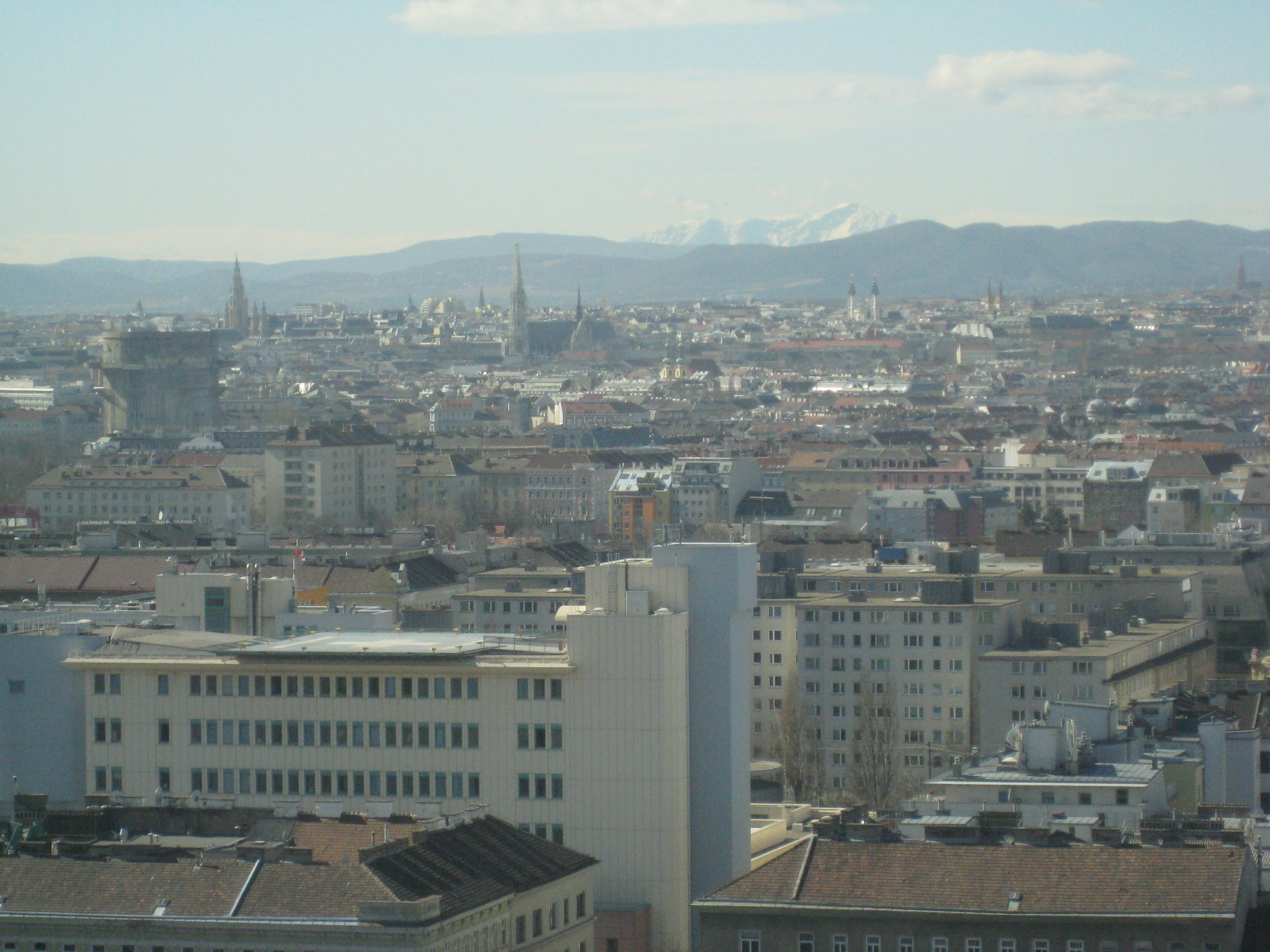
One group I teach is at a company in the Millenium Tower in the 20th district. It is the tallest office building in the city, and offers this spectacular view, looking south, from the conference room where I teach. The Danube is off to the left.

I get to ride this classy-looking elevator every time I teach at the office of one of the language schools, which is located in the very heart of the first district, just off the Graben and steps away from Stephansdom.
And here is what Stephansdom looked like at sunset the other evening as I left the office - a balmy evening, and the cafes and the pedestrian plaza were full. Perfect time to reward myself with a gelato combo - hazelnut and chocolate!
I've been teaching several classes at the Austrian motor club (their AAA), which is about 15 minutes north of the city limits in a town called Klosterneuberg, famous for its ancient monastery. Even before spring, the scenery was picturesque, so I enjoy going there even though it's a 45-minute commute each way and a 10-minute hike from the bus stop, up a fairly steep road.
I've just started some new classes at one of the country's major banks in the third district, and I pass the Wiener Konzert Haus every time I go there. The concert season is really kicking into high gear now, so I hope to treat myself soon, because, after all, they get the top orchestras and soloists. But I think I need to save a few more Euros before I do!

Have I mentioned lately how much the Viennese like to eat? This modest array is one of several in a series of shops in the shopping mall/lobby of one company where I teach. It greets (and tempts) me every time, even early in the morning.
This is a (surreptitiously taken) photo of the reception desk/counter at a huge client company, located in a corporate park in the 12th district. Employees scoop up the free fruit by the handful on their way to work. Smart company!

I wonder where my next assignment will take me ...